
Schools should never be battlegrounds: A global crisis demanding urgent action

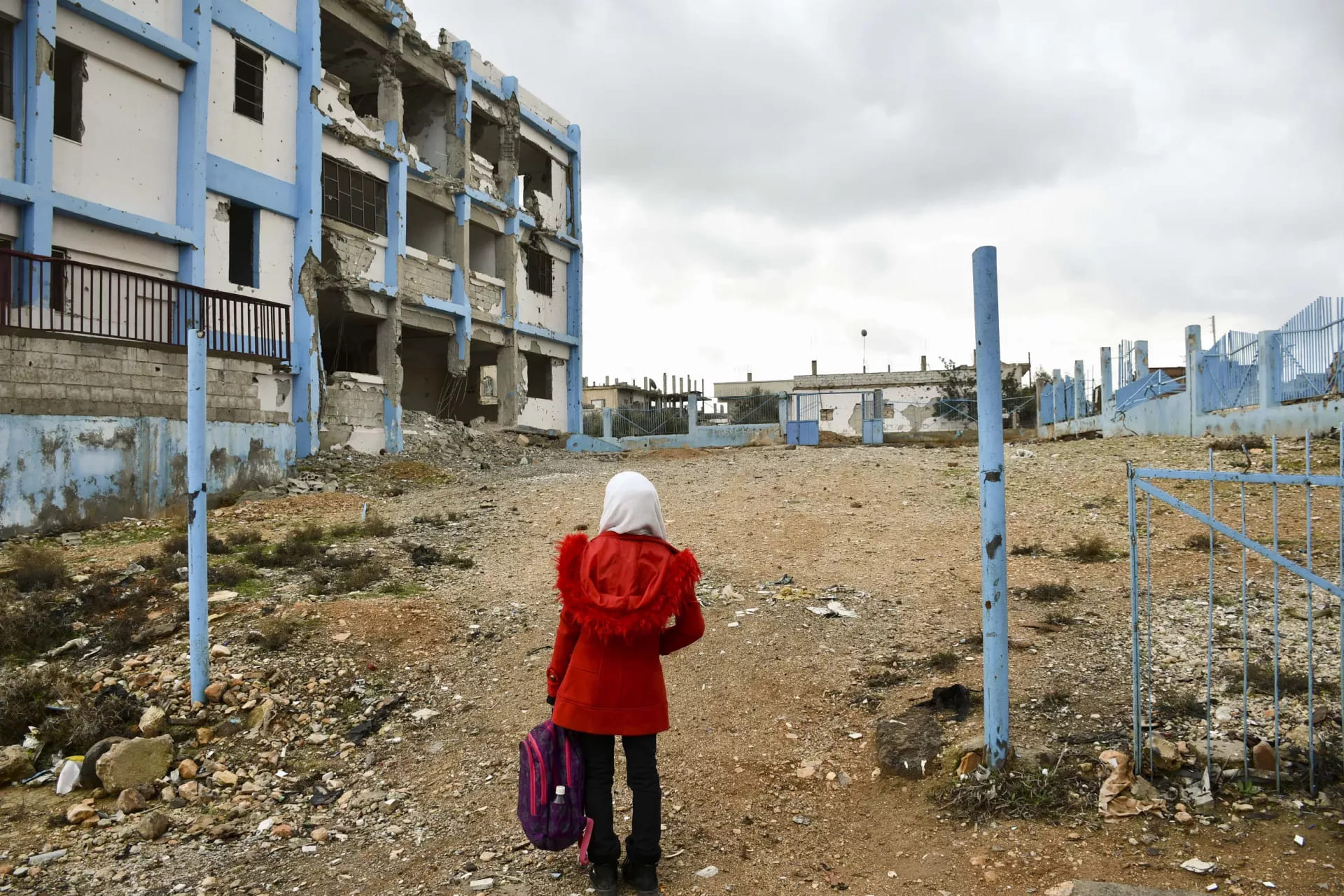
Woman walking amid the rubble of a school.
By Umayal Eswaran, Chairperson, RYTHM Foundation
A girls' elementary school in Minab, Iran, was struck on 1st March 2026 during military operations. The attack killed over 150 people, primarily schoolgirls aged seven to 12, who were simply trying to learn.
Children changing classes, some excited about their next lesson, and teachers settling their students. The smallest, most ordinary moments of a school morning, erased without warning or justification.
There is no strategic calculus that makes this acceptable.
Having spent years building safe learning spaces for vulnerable children through our work at Taarana and RYTHM Foundation, it is incomprehensible how anyone justifies targeting a school.
Without access to education, children in conflict zones are denied not only knowledge but also safety, stability, and the sense of normalcy that schools provide. In the end, an entire generation grows up knowing only war as their potential is stifled before it can blossom.
The tragedy in Iran is not an isolated incident. It is part of a global crisis that demands our immediate attention and action.
The devastating numbers
The statistics paint a horrifying picture of our collective failure to protect children's most fundamental right, the right to safe education. According to the 2025 UN Secretary-General's Annual Report on Children and Armed Conflict, there was a 44% increase in attacks against schools in 2024 compared to the previous year.
For every 100 school attacks in 2023, there were 144 in 2024
Between 2022 and 2023, there were around 6,000 attacks targeting students, educators, and educational institutions globally. The use of schools for military purposes rose by 20%, and over 10,000 students were killed, abducted, arrested, or harmed during this period alone.
According to the Save the Children analysis, attacks on schools, teachers and students tripled from 790 in 2020 to 2,445 in 2024, an almost three-fold increase in just five years. The UN reported over 41,000 incidents of violence against school-age children in 2024.
The countries most affected tell the story of a world failing its children: Israel and the Occupied Palestinian Territory recorded 8,554 violations, the Democratic Republic of the Congo 4,043, Somalia 2,568, Nigeria 2,436, and Haiti 2,269. In Ukraine alone, 1,850 educational facilities have been damaged since the conflict began, with 5.3 million children facing barriers to education and 115,000 completely out of school.
When promises aren't enough
The international community is not without tools to address this crisis.
As of November 2025, 122 countries have endorsed the Safe Schools Declaration, a political commitment launched in 2015 to protect students, teachers, schools and universities from attacks during armed conflict. UNESCO has noted that pupils in places dedicated to learning are protected under international humanitarian law.
Despite these commitments, the violence continues to escalate. The Declaration, while important, remains non-binding. Countries can endorse it while failing to implement concrete protective measures. The reduction in foreign aid by major donors in 2025 has had a devastating impact on education services in crisis contexts, with humanitarian actors forced to reduce their funding requests by 33% for education, leaving more than 33 million people in need outside the scope of aid planning.
What must be done
Countries which attack schools must face real consequences. The International Criminal Court should prioritise attacks on educational institutions as war crimes, while economic sanctions must hold perpetrators accountable.
Funding is also a form of protection, with 33% cut to humanitarian education budgets in crisis contexts is unconscionable at a moment when attacks are rising by 44%, and that funding must be restored with an emphasis on local leadership.
The upcoming Fifth International Conference on the Safe Schools Declaration in Nairobi must produce binding commitments, not just renewed promises. Countries must legislate protections, train military personnel, and establish monitoring systems.
Beyond governments, civil society organisations sustaining education in conflict zones must be protected, as attacks on schools rarely happen in isolation from broader crackdowns on the people working to rebuild them.
Enjoying this article?
Subscribe to get more stories like this delivered to your inbox.
Technology also plays an important role. Early warning systems, real-time monitoring of educational facilities, and coordination platforms can enable faster and more effective responses when schools come under threat.
A personal call to action
Children deserve to believe that school is safe. The little girl in rural Malaysia learning to read, the boy with autism discovering his musical talents, the indigenous child maintaining her cultural identity while gaining new skills, they all need the same thing — a classroom where they can learn without fear.
The children of Minab should be doing their homework tonight. Instead, families are planning funerals. This is not the world we promised our children, but it is the one we have created through our inaction.
The children of the world are watching. They're asking whether we will protect their right to dream, to learn, to build a better future. Our answer cannot be another conference, another declaration, another empty promise.
Our answer must be action.
Umayal Eswaran is Chairperson of RYTHM Foundation and founder of Taarana, Malaysia's first dedicated centre for children with special needs. She has spent over a decade working to create inclusive educational opportunities for vulnerable children across Southeast Asia and beyond.
Contributing writer at The Independent News