
What does “common security” really mean today?

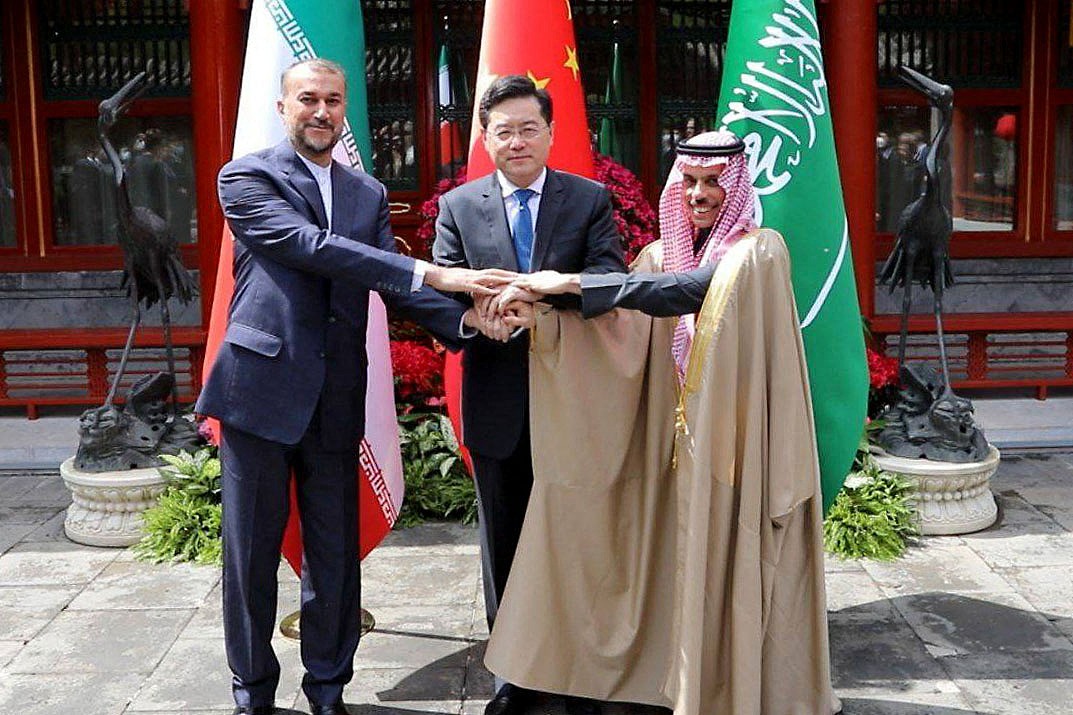
This handout picture provided by the Iranian foreign ministry shows Iran's Foreign Minister Hossein Amir-Abdollahian (L) shaking hands with Saudi Foreign Affairs Minister Prince Faisal bin Farhan and Chinese Foreign Minister Qin Gang (C) during a meeting in Beijing on April 6, 2023. The foreign ministers of Middle East rivals Iran and Saudi Arabia met in Beijing, paving the way for normalised ties under a surprise China-brokered deal.]
By Niu Honglin
As a podcaster, I work on shows with different themes. Some are analytical. Some are historical. Some are very entertaining. But this one stayed with me in a different way.
This article comes from the podcast series Stories of Xi Jinping. It’s about global governance and the idea of a “shared future for humanity”. When we planned the episode on security, I didn’t expect it to feel quite this personal. But the more I worked through the material, the more it became clear that “security” today is no longer an abstract concept. It shows up in everyday life, often in quiet, unexpected ways.
While working on this episode, I kept thinking about how much the meaning of security has changed. It’s no longer just about borders or military strength. Today, security is tied to whether conflicts can be defused before they explode, whether people feel safe enough to rebuild their lives, and whether countries can cooperate when trust is fragile.
At the Boao Forum for Asia in 2022, Chinese President Xi Jinping described security as the precondition for development and called for a vision that is common, comprehensive, cooperative, and sustainable. Hearing that, I found myself asking a very practical question: what does this idea look like when it leaves the conference hall and meets the real world?
When dialogue replaces confrontation
Countries differ in history, political systems, and interests. That reality isn’t going away. The question is how those differences are managed. One approach is coercion. Another is mediation.
China’s approach to security places heavy emphasis on dialogue, respect for sovereignty, and non-interference, especially in regions where outside intervention has often made things worse.
The Middle East is one such region. Years of proxy conflicts and hardened positions have left little space for trust. Saudi Arabia and Iran, after severing diplomatic ties in 2016, had almost no direct communication for years. Religious tensions deepened into regional rivalry.
That’s why the events of March 2023 mattered. After a series of high-level visits and quiet diplomacy, Saudi Arabia and Iran agreed to restore diplomatic relations, with China acting as mediator. At the closing ceremony, representatives from the three countries sat in an equilateral triangle, a small but deliberate symbol of equality.
One Saudi official later acknowledged that China maintained working relationships with both sides. It wasn’t trying to offer a ready-made “solution.” It was offering space for dialogue.
Al Jazeera later paraphrased a famous saying: seek peace, even if you have to go as far as China. The phrase stuck with me, firstly because it was clever, but more importantly because it captured a shift. In a world accustomed to power politics, an unbiased stance can be a form of leverage.
Security shows up in small human moments
Security also looks very different when you see it up close.
In South Sudan, Chinese peacekeepers patrol refugee camps, mediate local disputes, and help rebuild basic public safety. One policewoman, Gao Yali, often spent time simply listening to displaced families. Sometimes she held someone’s hand. Sometimes she offered a hug.
She remembered a woman named Lisa, too weak to lift her arms when they first met. Gao and her colleagues returned again and again with food and supplies. Over time, Lisa recovered. Now she greets them with her child whenever they visit.
Over the past three decades, China has sent more than 50,000 peacekeepers to UN missions across nearly 30 operations. Today, it is the largest contributor of peacekeepers among the permanent members of the UN Security Council. These numbers matter, but the human stories explain why they matter.
New risks, new rules
Not all security threats are visible. Cyberattacks, biological risks, and emerging technologies are not contained by borders either.
At the 2022 Review Conference of the Biological Weapons Convention, negotiations had been stalled for years. Through mediation and sustained engagement, China helped move talks forward, contributing to a final document that broke a long impasse. Delegates responded with extended applause, celebrating this rare moment in arms control diplomacy.
In recent years, China has also proposed initiatives on data security, AI governance, and ecological security, arguing that new technologies and environmental systems require shared rules, not unilateral dominance.
Enjoying this article?
Subscribe to get more stories like this delivered to your inbox.
These efforts reflect a broader shift. Non-traditional security issues are no longer peripheral. They are central to how states interact and how trust is built.
Development as the foundation of security
One line from President Xi Jinping’s Global Security Initiative kept resurfacing for me: without development, there is no security.
At the Kribi Deep Water Port in Cameroon, that connection becomes visible. Once a small fishing village, Kribi is now home to a major port built through China-Cameroon cooperation. Since operations began, it has generated billions in customs revenue, created stable jobs, and even contributed to a noticeable drop in local crime.
Security here isn’t enforced by soldiers. It’s built through livelihoods.
Why this story matters
What ties these examples together is a shift away from zero-sum thinking. Security is no longer something one country can hoard. Instability spreads easily. So do solutions.
In the podcast, these stories unfold through voices and ambient sounds: refugee camps, ports, negotiation halls, open seas. That texture adds something text can’t fully capture. If this topic interests you, I’d recommend listening to this episode in our new podcast Stories of Xi Jinping.
At a time when fear often dominates discussions about global security, these stories suggest another approach: one rooted in dialogue, shared responsibility, and the belief that lasting security begins with people living better, more stable lives.
More from the podcast series are available:https://podcasts.apple.com/cn/podcast/stories-of-xi-jinping/id1689566035
Niu Honglin is a producer and host with CGTN. She is also one of the editors of Stories of Xi Jinping.
China Global Television Network