
'No rift or conflict': PH insists Philippines-China ties remain intact despite WPS clashes and sanctions on defence chief

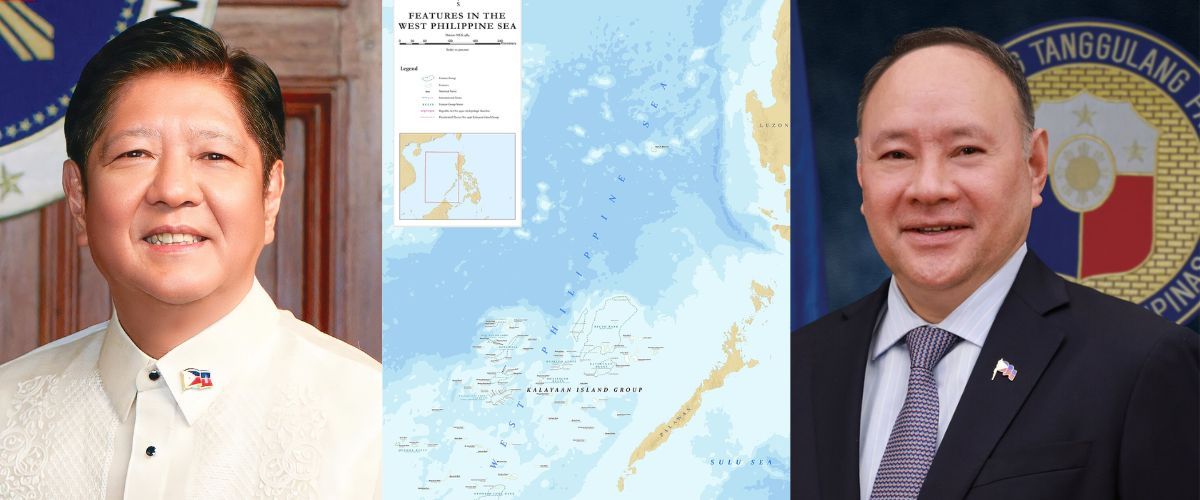
Photo: (left) PH President Bongbong Marcos, (center) West Philippine Sea, (right) Defence Secretary Gilbert Teodoro
PHILIPPINES: The Marcos administration is maintaining that the Philippines and China enjoy a good bilateral relationship, even as the two countries’ officials trade increasingly sharp words over the West Philippine Sea, and Beijing has imposed personal sanctions on the Philippine defence secretary.
The Philippine News Agency (PNA) reported that Palace Press Officer Claire Castro made the assertion on Monday (June 29) at a Palace briefing, reiterating that President Ferdinand Marcos Jr. wants the Philippines to continue pursuing its national interests and protecting its sovereign rights through diplomatic means rather than provocation or aggression.
“We are not engaging in provocation”
Castro stressed that Manila's approach to the WPS dispute has been measured and lawful, drawing a clear distinction between asserting rights and escalating tensions.
“We could protect our rights; we could fight for our interests in a diplomatic manner. Wala naman po tayong probokasyon, wala naman din tayong aggression, at wala din naman pananakop na ginagawa ang Pilipinas sa kahit anong teritoryo,” Castro said, as quoted by the PNA. (Translation: “We are not engaging in provocation, aggression, or occupying any territory.”)
She also framed the sharp exchanges between Philippine and Chinese officials as both sides simply implementing their respective laws and policies, not as evidence of a deteriorating relationship.
“Ang China ay tumutupad sa kanilang batas at polisiya. Ganoon din po ang Pilipinas. Si [Defence] Secretary Gibo ay tumutupad lang din sa kanyang mandato, kagaya rin po ng mga opisyal ng bansang China,” she added, translating to: “China is implementing its laws and policies. The Philippines is doing the same. Defence Secretary Gilberto Teodoro Jr. is simply carrying out his mandate, just like officials of China.”
Downplaying the rift despite the sanctions
When asked directly how the administration characterises the relationship given the escalating rhetoric, Castro was equally measured.
“Sa atin po, sa parte ng Pilipinas, tinuturing pa ring maganda ang relasyon ng ating bansa sa bansang China. Hindi naman po nagkakaroon ng anumang rift o sigalot dahil lang sa mga mensahe ng ating defence secretary,” she said. (From the Philippine side, we still consider our relationship with China to be good. There is no rift or conflict simply because of the statements made by our defence secretary.)
The remarks come despite Beijing having imposed sanctions on Defence Secretary Teodoro and his family, barring them from entering mainland China, Hong Kong, and Macau. Others would perceive this move as something that would typically signal significant diplomatic friction.
Teodoro at the centre of the friction
Teodoro has become the Marcos administration’s most outspoken critic of China’s conduct in the West Philippine Sea, consistently accusing Beijing of coercive and unlawful activities that violate international law and undermine Philippine sovereign rights. He has called out the use of maritime militia vessels, the obstruction of Philippine resupply missions, and what he has described as Chinese disinformation efforts surrounding the maritime dispute.
Enjoying this article?
Subscribe to get more stories like this delivered to your inbox.
Chinese officials have repeatedly pushed back against his statements, and the sanctions against him and his family represent one of the most concrete expressions of Beijing's displeasure with Manila's posture under the Marcos administration.
A delicate balancing act
The Marcos administration’s position, firm on sovereignty but diplomatic in tone, shows a carefully calibrated stance to one of Southeast Asia’s most sensitive bilateral relationships. Manila is simultaneously deepening security ties with the United States while attempting to keep economic and diplomatic channels with Beijing open, all while managing an active maritime dispute that shows no sign of resolution.
Whether that balance can be sustained as confrontations in the West Philippine Sea grow more frequent and the rhetoric on both sides grows sharper remains one of the more consequential open questions in the region’s geopolitical landscape.
Writer