
One thousand years ago, the world looked very different — and Europe was not yet the centre of it
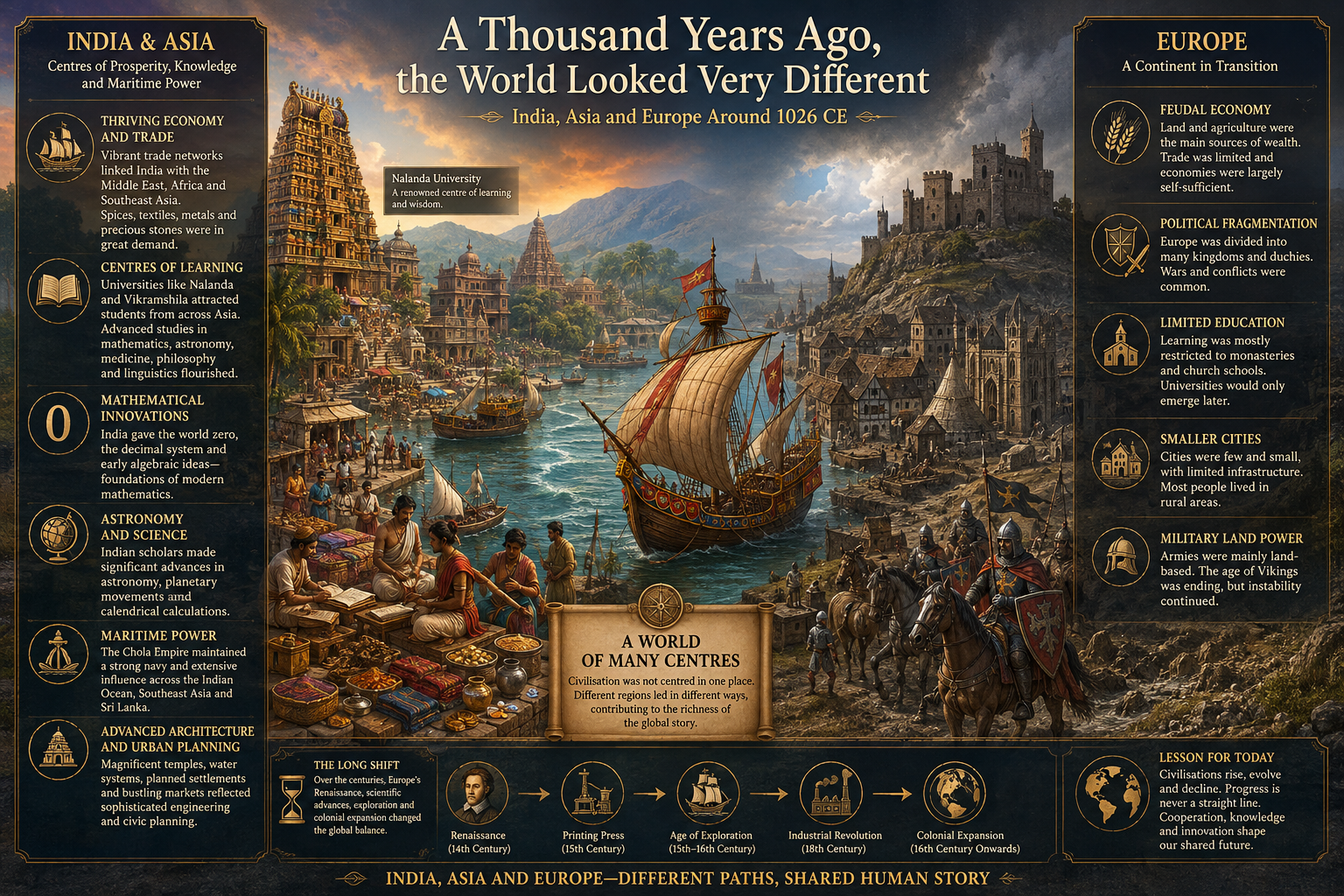
A thousand years ago, the world looked very different. India and Asia were major centres of trade, knowledge, culture and maritime power, while Europe was still undergoing political and economic transformation. History reminds us that global power is never permanent — it shifts with time, innovation and circumstance.
A thousand years ago, the world did not revolve around Europe. Power, wealth, learning and technological achievement were spread across several regions, and much of what we now think of as the foundations of modern civilisation was being developed far from the European continent.
Across Asia, and particularly in the Indian subcontinent, cities were busy, trading networks stretched across seas, scholars pursued mathematics and astronomy, and ambitious rulers built monuments that still dominate the landscape today. Europe, by comparison, was only beginning a long process of political and economic transformation that would eventually help produce the Renaissance and, centuries later, European global dominance.
That contrast is worth remembering because history can look deceptively inevitable when viewed backwards. Europe’s later rise was not preordained. A thousand years ago, the balance of civilisation looked rather different.
India and the Economy of the Medieval World
The Indian subcontinent was one of the important engines of economic activity around a thousand years ago. Historical economic models have sometimes estimated that roughly one-third of the world’s economic output came from the Indian region. But such figures need to be handled with care. There were no modern national accounts or reliable statistical records at the time; these are reconstructions made by historians and economic historians.
What is less controversial is the scale and importance of India’s agricultural production, handicrafts and trade.
Indian merchants participated in commercial networks that connected the subcontinent with the Middle East, Africa and Southeast Asia. Spices, textiles and metal products travelled along these routes, while Indian cotton textiles became particularly sought after in international markets.
Europe’s position was different. Much of Western Europe remained organised around a feudal economy in which land and agricultural production were the principal sources of wealth. Urban centres were relatively limited, and long-distance commercial networks were not yet as extensive as those developing across parts of Asia. Political instability and frequent conflict also placed constraints on economic growth.
It would be a mistake, however, to imagine Europe as simply stagnant. It was changing too. The difference was one of pace, scale and circumstance.
When Learning Travelled Across Asia
If there is one thing that complicates the familiar story of a supposedly dormant medieval world, it is the movement of knowledge.
India was home to important centres of learning, including Nalanda and Vikramshila, which attracted students from different parts of Asia. Scholars studied mathematics, astronomy, medicine, philosophy and linguistics, building on intellectual traditions that had developed over centuries.
India’s mathematical contributions were particularly consequential. The concept of zero, the decimal system and early algebraic ideas became part of a wider history of mathematical development. These ideas travelled beyond the subcontinent, reaching the Middle East and, eventually, Europe through translation, scholarship and trade.
Astronomy was another area of serious study. Indian astronomers observed planetary movements and developed sophisticated systems for calculating calendars.
Europe’s educational institutions were at a different stage. Formal universities had not yet fully emerged, and much learning was centred on monasteries and church schools. That would change. From the 12th and 13th centuries, institutions such as Bologna and Oxford began to take shape, creating new centres of European intellectual life.
The point is not that one civilisation was “advanced” while another was “backward”. It is that different societies were solving different problems, building different institutions and accumulating knowledge at different moments.
The Cholas and the Power of the Sea
On the political and military map of the period, there was no single global superpower. Regional empires mattered enormously.
In South India, the Chola Empire emerged as one of the strongest naval powers of its time. Its maritime strength helped it project influence across the Indian Ocean and into Southeast Asia, while supporting commercial and diplomatic connections with places including Sri Lanka, the Malay Peninsula and parts of Southeast Asia.
The evidence survives not only in historical records and inscriptions but also in cultural influences that can still be traced across the region.
Europe, meanwhile, remained politically fragmented. The Viking era was drawing to a close, but warfare among kingdoms and other political entities remained common. There were powerful rulers and formidable military forces, but Europe lacked the kind of political integration that would later allow some European states to project power across the globe.
Again, hindsight can distort the picture. We know what Europe would eventually become. The people living a thousand years ago did not.
Cities, Temples and the Business of Everyday Life
Some of the most revealing evidence of a society’s sophistication can be found not in its armies but in its cities.
Across India, architecture reflected considerable knowledge of engineering and organisation. Large temple complexes served purposes that went well beyond worship. They could function as economic and social centres, while markets, water-storage systems and planned settlements supported growing communities.
South Indian temple architecture, in particular, became renowned for its elaborate carvings and structural engineering.
European cities of the same period were generally much smaller. London and Paris had not yet become the major urban centres we recognise today. Many settlements developed around castles and other centres of political power, with relatively limited infrastructure.
That would change as European commerce expanded. Trade encouraged urban growth, cities became wealthier, and new economic institutions emerged.
Civilisations do not simply rise and fall in a straight line. They accumulate advantages, lose them, adapt and sometimes begin again.
The Long Shift Towards Europe
Over the centuries that followed, the balance began to change.
The European Renaissance brought renewed intellectual and artistic activity. Printing technology made it possible to reproduce and circulate ideas on a scale that earlier generations could scarcely have imagined. Improvements in navigation helped European powers establish increasingly ambitious maritime trade networks.
Enjoying this article?
Subscribe to get more stories like this delivered to your inbox.
Europe’s transformation was not caused by a single invention or event. It was the product of several developments interacting over time — political competition, commerce, scientific inquiry, technological change and, eventually, overseas expansion.
At the same time, parts of Asia, including India, experienced political instability and regional conflicts that affected their position in international commerce. Later, European colonial expansion fundamentally reshaped global economic relationships.
By then, the balance of power had changed dramatically.
What We Get Wrong When We Read History Backwards
There is a temptation in modern history to treat Europe’s eventual dominance as though it were always destined to happen. It was not.
A thousand years ago, India and other parts of Asia were major centres of trade, learning, culture and political power. Europe was following its own, very different trajectory. Centuries later, Europe would become the dominant force in much of the world, but that outcome tells us little about what would have seemed likely to someone living in the year 1026.
That may be the most useful lesson of all.
Civilisational progress is rarely a straight road. Regions lead, fall behind, recover and reinvent themselves. Political stability can accelerate prosperity; conflict can undermine it. New technologies can shift the balance unexpectedly. Knowledge does not belong permanently to one civilisation, nor does economic power.
India, Asia and Europe each contributed to the making of the modern world. Their histories are not separate stories, but parts of the same long human story — one in which the centre of gravity has never stayed still for very long.
And if history tells us anything about the future, it is that the world we assume is permanent may simply be the world we happen to be living through.
Contributing writer at The Independent News