
Trump's latest tariffs on over 80 countries face fresh legal scrutiny as allies condemn move

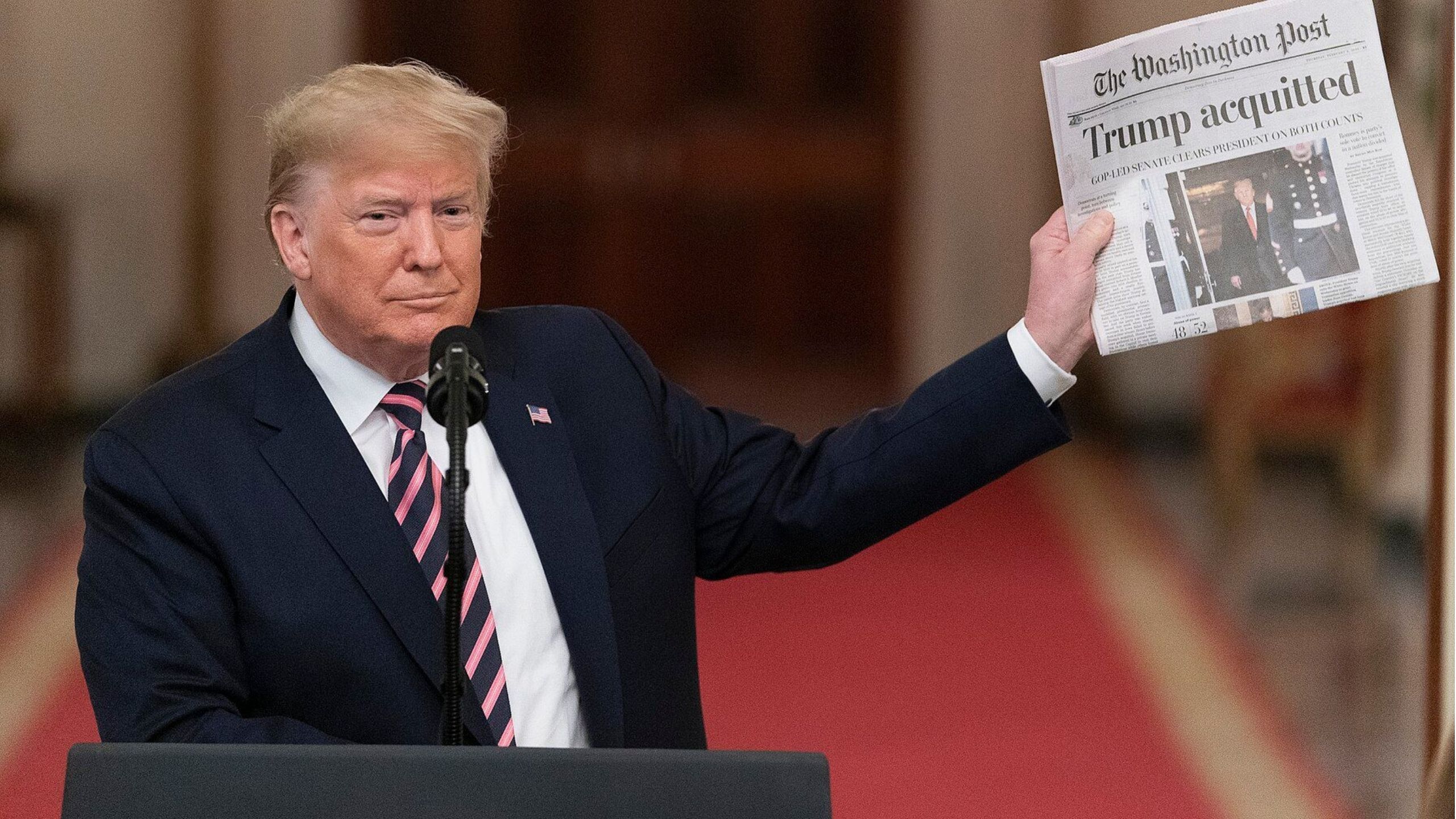
Photo: President Donald Trump displaying the headline "Trump acquitted" in 2020
INTERNATIONAL: President Donald Trump has rolled out a new wave of tariffs on more than 80 countries, replacing a 10% global duty that expired at midnight on Friday with levies of between 10% and 12.5% on dozens of major trading partners, including the UK, Mexico, Canada, Australia, India, China, and all 27 EU member states.
According to The Guardian, the new tariffs, announced late Thursday by US Trade Representative Jamieson Greer, invoke Section 301 of the Trade Act of 1974, which targets countries that engage in forced labour practices. The move effectively substitutes for the blanket 10% tariff Trump imposed in February, which itself was a replacement for the sweeping levies that the US Supreme Court struck down in a 6-3 ruling as an unconstitutional presidential overreach.
Why the legal questions aren’t going away
The latest tariffs are already attracting scrutiny from legal experts who say the administration may again be exceeding its authority. Alan Wolff, senior fellow at the Peterson Institute for International Economics and former deputy director-general of the WTO, wrote in an analysis on Thursday that the new tariffs “again raise the question of whether the president has the legal authority to determine and implement US tariff policy — an authority that the constitution vests in Congress.”
“The answer is no: Congress did not delegate authority of such breadth to the president. It cannot constitutionally do so,” Wolff wrote, as quoted by The Guardian. “These new tariffs would represent another case of presidential overreach. If they were challenged in court, the Supreme Court would likely overturn them.”
Allied reaction: Swift and sharp
The response from US allies was immediate. The Guardian reported that Australia and Brazil both described the tariffs as unjustified and said they would seek to have them removed. Norway’s foreign minister said there was no basis for the new levies.
The EU’s foreign policy chief Kaja Kallas said the bloc would seek clarification from Washington, noting it had honoured commitments under a transatlantic trade agreement reached last year and viewed the tariffs as “a shock.”
Canada, one of America’s largest trading partners and itself a leader in addressing forced labour imports, pushed back particularly hard. “Canada should not be targeted,” the country said, with the Canadian Chamber of Commerce questioning the timing. “If the intent is truly to address forced labour, the focus should be a coordinated approach through a multilateral mechanism. The timing of this is somewhat suspect as previous rounds of tariffs sunset,” said Matthew Holmes, the chamber’s executive vice-president.
Netizens react
The announcement drew sharp responses online, with commenters focusing less on the legal technicalities and more on what they see as the political and economic motivations behind the move.
Several pointed to the domestic cost of the tariffs as the most immediate concern. “And us, because this airhead scumbag thinks he’s allowed to levy taxes on Americans by illegally imposing tariffs again. Inflation was already excessive enough,” one commenter wrote, framing the tariffs not as a trade tool but as a domestic tax that American consumers will bear.
Others took a broader geopolitical view. “I honestly think the western world now needs to boycott American goods completely. I will be doing, at least. And it appears the EU is slowly but surely decoupling. The US will get what they want and realise it’s not what they wanted: isolation and authoritarianism,” one user wrote.
A third commenter described what they characterised as a deliberate and repeating financial cycle. “The tariff grift was highly successful at stealing from the average American consumer so now it’s just going to be a repeat thing. Trump imposes tariffs, they are in effect for a while, the corrupt court aka Supreme Court shoots it down, and then Trump’s donors get massive refunds. Rinse and repeat,” their comment stated.
Enjoying this article?
Subscribe to get more stories like this delivered to your inbox.
One commenter tied the tariff announcement directly to the ongoing Iran conflict, arguing it was a deliberate distraction. “He is trying to change the news cycle away from the Iran conflict. This is his way of trying to pull you away from the bigger problem. Oil and gas prices are going to get much much worse, and what does he do? Tariff the world.”
The political stakes heading into midterms
The cumulative economic impact of the tariff regime, i.e. higher consumer prices, strained allied relationships, and ongoing legal uncertainty, presents a real political challenge for Republicans heading into November’s midterms. With the Supreme Court having already struck down one version of the tariff policy and legal experts warning the new version faces similar vulnerabilities, the administration’s trade agenda remains as contested in the courts as it is at the ballot box.
For now, the tariffs are in effect. Whether they survive legal challenge, and whether the forced labour justification holds up to the same scrutiny that sank the earlier emergency powers approach, will likely be answered in the months ahead.
Read related: US to hit Brazil with 25% tariffs from July 22, with total burden potentially reaching 37.5%
Writer