
Sreemangal’s Green Legacy: How Bangladesh’s Tea Capital Is Brewing a New Story of Excellence

Sreemangal’s Green Legacy
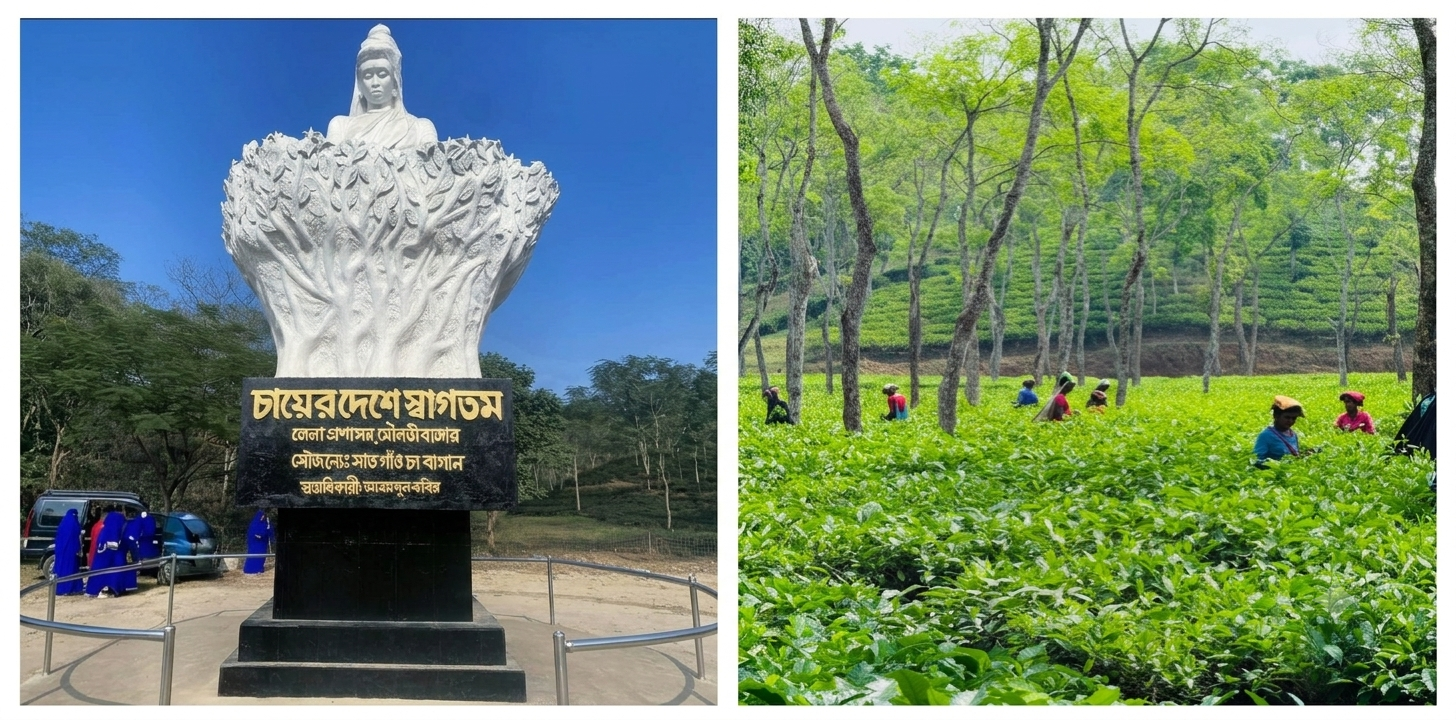
Long before sunrise, the tea gardens of Sreemangal are already alive with quiet purpose. As the first light settles across dew-laden bushes, tea workers move through neat rows carrying woven bamboo baskets on their backs. With practised precision, they pluck the industry's most prized harvest—two leaves and a bud. From these tender shoots comes a tea whose aroma and character travel far beyond Bangladesh's borders.
It is a ritual repeated every morning across a landscape where nature, history, and human endeavour have become inseparable. Nestled among rolling hills, forests, and wetlands, Sreemangal has earned its reputation as Bangladesh's tea capital. This year, the region has added another chapter to its long story of excellence.
At the Sixth National Tea Day celebrations, held in Sreemangal on 20 June 2026, the Bangladesh Tea Board honoured individuals and institutions for outstanding contributions to the country's tea industry. Among the highest distinctions was the award for producing Bangladesh's finest-quality tea, presented to Madhupur Tea Garden, owned by Kedarpur Tea Company Limited. According to the Tea Board, the estate earned national recognition for consistently maintaining international quality standards while producing tea of exceptional quality.
The accolade is more than a tribute to one estate. It reflects the growing maturity of an industry that remains one of Bangladesh's oldest export sectors and an enduring pillar of the national economy.
Kedarpur Tea Company Limited is among the country's most respected tea producers, operating four major estates: Jhimai in Kulaura, Madhupur in Bahubal, and Dinarpur and Satgaon in Sreemangal. Through decades of experience, modern estate management and a sustained commitment to quality, the company has established itself as one of the leading names in Bangladesh's tea sector.
Its Managing Director, Laila Rahman Kabir, has led the company since 1975, while Nihad Kabir serves as Director. Laila Rahman Kabir is also a pioneering figure in Bangladesh's corporate history. She became the first woman to chair the Bangladesh Tea Association, the Metropolitan Chamber of Commerce and Industry (MCCI), and the Bangladesh Employers' Federation (BEF). In recognition of her contribution to business and the national economy, she received the Daily Star–DHL Bangladesh Business Award in 2014.
The company's heritage is closely connected with one of Bangladesh's distinguished public figures. Laila Rahman Kabir's late husband, Ahmadul Kabir, was an economist, journalist, politician, and former Member of Parliament. Once the proprietor of Satgaon Tea Estate, he also served as editor of the influential daily Sangbad. While studying at the University of Dhaka, he was elected the first Vice-President of the Dhaka University Central Students' Union (DUCSU) in 1945–46. His career later extended across banking, industry, journalism, and politics, including serving as a founding director of Eastern Mercantile Bank and IFIC Bank. Today, the family's publishing legacy continues through their son, Altamash Kabir (Mishu), Editor and Publisher of Sangbad.
Bangladesh's relationship with tea dates back almost two centuries. Experimental cultivation began in Chattogram in 1840 before commercial production was established at Malnichhara Tea Estate in Sylhet in 1857. Since then, Sreemangal has grown into the country's most celebrated tea-producing region. Home to around 50 tea estates, surrounded by hills, forests, wetlands and rich biodiversity, it is widely regarded as Bangladesh's tea paradise.
Visitors entering Sreemangal along the Dhaka–Sylhet Highway are greeted by one of the region's most recognisable landmarks. Standing approximately 24 feet high beside Satgaon Tea Estate in Muchai is the iconic Tea Girl sculpture. Depicting a tea worker carrying a basket while plucking fresh leaves, the monument honours the labour, resilience and dignity of the thousands of workers whose efforts sustain Bangladesh's tea industry.
The sculpture was commissioned by the district administration, financed by Satgaon Tea Estate and created by sculptor Sanjit Roy. Construction began in 2009 and was completed the following year. Today, it has become one of Sreemangal's defining symbols, drawing visitors from across the country who pause to photograph the monument against a backdrop of emerald tea gardens and rolling hills.
National Tea Day also celebrated excellence across the wider industry. Sri Gobindapur Tea Estate was recognised for achieving the country's highest tea yield per acre, while The Consolidated Tea & Lands Company (Bangladesh) Limited received the award for outstanding tea exports. Mirzapur Tea Estate was honoured for its commitment to workers' welfare, and Kazi & Kazi Tea Estate Limited was recognised for innovation in tea marketing.
Enjoying this article?
Subscribe to get more stories like this delivered to your inbox.
Alongside the awards, the Bangladesh Tea Board launched two digital platforms—Bangladesh Tea Industry and Duti Pata Ekti Kuri ("Two Leaves and a Bud")—to support the sector's continuing modernisation. Meanwhile, the Bangladesh Tea Research Institute is expanding the industry's future through high-yielding tea clones and a growing range of value-added products, including jasmine, rose, lemon, masala and chocolate teas, broadening Bangladesh's appeal in increasingly competitive international markets.
Yet the essence of Bangladesh's tea industry cannot be measured by production figures or export earnings alone. Every cup reflects the richness of the soil, the cool morning mist drifting across the hills, the painstaking work of tea pickers, the vision of estate owners and more than a century and a half of accumulated knowledge.
The national recognition awarded to Madhupur Tea Garden therefore represents something larger than commercial success. It affirms that Bangladesh's tea industry continues to thrive by combining tradition with innovation and craftsmanship with ambition, and standing quietly at the gateway to Sreemangal, the Tea Girl remains a powerful reminder that the country's tea story is ultimately one of people—of perseverance, heritage, excellence, and a landscape whose beauty has shaped one of Bangladesh's most enduring industries.
Contributing writer at The Independent News