
Balishira Hill Uprising: Bangladesh’s Forgotten Peasant Struggle for Land, Dignity, and Justice

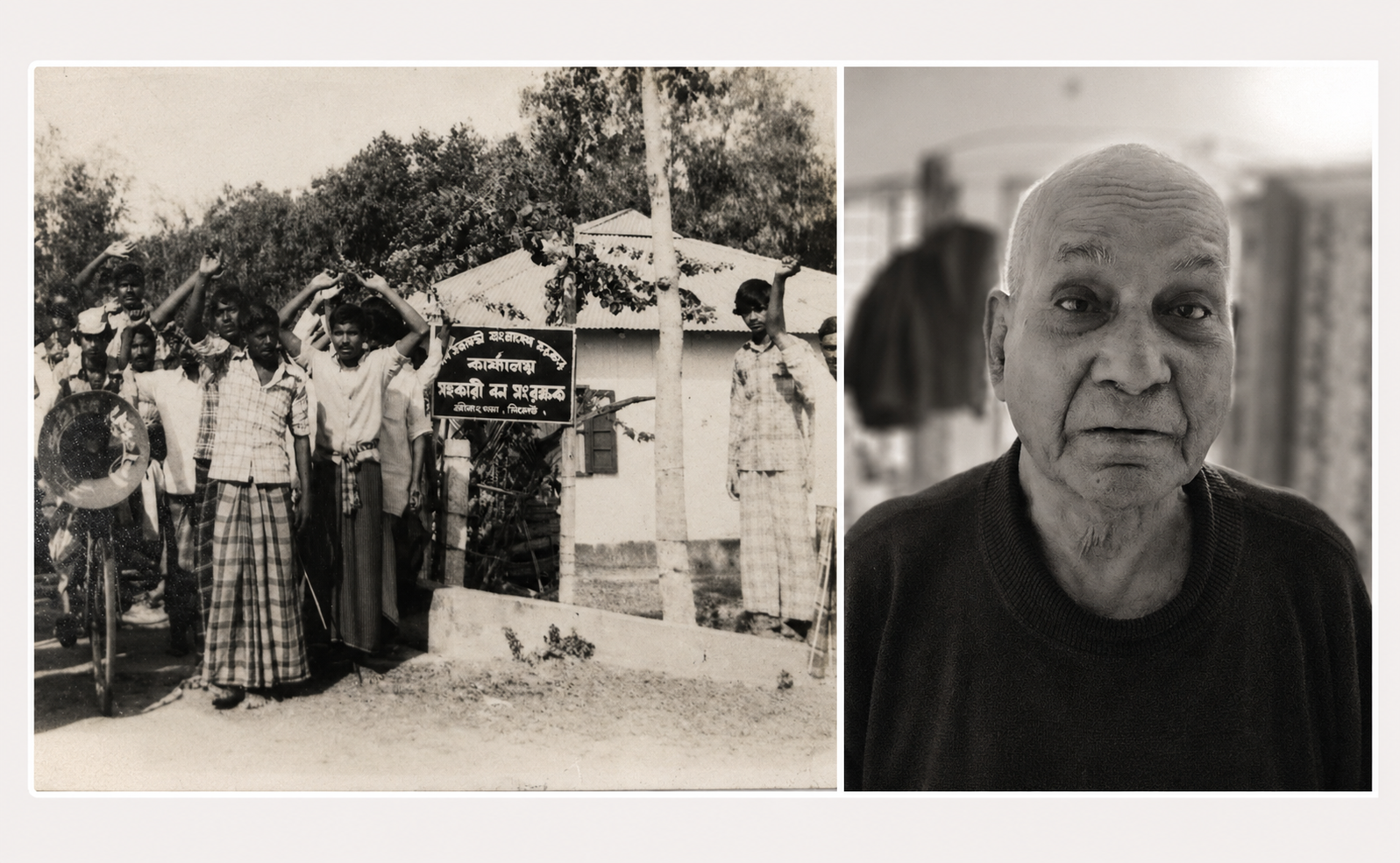
On February 19, 1963, thousands of peasants in Balishira Hill rose against the loss of their ancestral land and forest resources. Farmer Ganu Miah and 19-year-old student Salik Miah were killed in the ensuing crackdown. More than six decades later, their struggle remains a powerful but largely forgotten chapter in Bangladesh’s history of land rights, dignity and justice. In the picture left: A historic 1979 photograph of a procession associated with the Balishira Hill movement. Right: 87-year-old Rasendra Datta Choudhury, the then secretary of the Balishira Hill movement and now its only surviving leader.
On February 19, 1963, long before Bangladesh emerged as an independent nation, thousands of peasants gathered in Balishira Hill in what was then East Pakistan. They were not demanding political power. They were fighting for something more fundamental: the right to remain on ancestral land and to preserve the forests and natural resources on which their families had depended for generations.
The confrontation ended in bloodshed.
Eighty-year-old farmer Ganu Miah was shot dead. Nineteen-year-old student Salik Miah, a matriculation candidate, was critically wounded and later died after police allegedly denied him water while he was being held at Sreemangal Police Station.
Their deaths transformed February 19 into what local communities came to remember as Balishira Martyrs’ Day—a day of remembrance distinct from Bangladesh’s better-known February 21, the Martyrs’ Day associated with the 1952 Language Movement.
More than six decades later, the Balishira uprising remains one of the lesser-known episodes of the region’s history. Yet its story deserves attention far beyond Sreemangal. It speaks to questions that remain central across South Asia and the developing world: who controls land, whose livelihoods count in the pursuit of economic development, how indigenous and rural communities are protected, and what happens when powerful economic interests collide with the rights of people who have little political power.
In the early 1960s, wealthy interests sought to acquire 16,060 acres of land in Balishira Hill, then under Sreemangal Thana of Sylhet District and now within Moulvibazar. Some 12,000 acres were earmarked for new tea plantations.
For the communities living on the hills, the proposed expansion represented a direct threat to their homes and livelihoods. Tipra tribespeople and other local residents, including descendants of tea labourers, landholders, tenants, woodcutters, hill workers, day labourers and small farmers, had lived there for generations.
Their relationship with the land was not simply commercial. The forests provided bamboo, cane, hemp and timber, which families collected and sold in local markets to survive. Their customary rights to the land and its resources had been recognised and maintained over generations.
The proposed expansion of tea cultivation changed that balance.
As wealthy interests began securing government leases and taking control of plots, local people faced the prospect of displacement from land that had sustained their communities for generations.
The conflict that followed was therefore not simply a dispute over agricultural development. It was a confrontation between competing visions of land: one that treated it as an economic asset for large-scale commercial production, and another that regarded it as the foundation of community life and survival.
On February 19, 1963, more than 2,000 peasants—including landholders, tenants, hill workers and day labourers—gathered in Balishira to defend their ancestral rights.
Among the powerful leaseholders involved were MNA Keramat Ali, Hamidur Rahman, Mahmudur Rashid and M.M. Ispahani. Police support was mobilised against the protesters. The administration imposed Section 144, prohibiting assembly, and dispatched magistrates to suppress the gathering.
The peasants responded by setting fire to parts of the Julekhanagar Tea Estate.
As they returned, they encountered a police blockade near Kalighat Tea Garden. Trucks and armed personnel were deployed to stop them. The demonstrators nevertheless advanced and seized seven rifles from the police.
The confrontation escalated rapidly.
The magistrate ordered the police to open fire.
According to accounts of the incident, police officers took cover beneath vehicles and fired indiscriminately at the largely unarmed crowd.
Ganu Miah, an 80-year-old farmer, was killed at the scene.
Salik Miah, only 19 and preparing for his matriculation examination, was seriously wounded.
Eight men attempted to carry the injured student to Kalighat Hospital. Armed police intercepted them and forcibly took both Salik Miah and the body of Ganu Miah.
At Sreemangal Police Station, the dying student reportedly cried, “Water! Please, give me water!”
He was denied water and died soon afterwards.
The violence did not end with the deaths.
Those who had surrendered the seized rifles to local chairman Asidullah were subsequently arrested. Hundreds of people were implicated in cases that local accounts describe as fabricated. Police raids, arrests and torture followed.
Fear spread across southern Balishira. Men fled their homes. Women were also subjected to atrocities.
What had begun as a land dispute had become a major confrontation between rural communities and the state-backed interests seeking control of their land.
But the repression also produced an unexpected consequence: it helped transform a local protest into a wider political movement.
On February 23, prominent leaders arrived in Sreemangal, including Nawab Ali Safdar Khan, president of the Sylhet district committee of the National Awami Party (NAP); Pir Habibur Rahman; Revolutionary Md. Mafiz Ali Tara Miah; Syed Akmal Hossain; Advocate Monir Uddin; Mofiz Ali, General Secretary of the East Pakistan Tea Workers’ Union; Syed Motiur Rahman; Rasendra Datta Choudhary; and peasant leader Abdul Malek.
They joined local leaders Shahjahan Miah, Elaich Miah and Abdul Khalek in organising the population and bringing wider attention to the events.
The movement demanded the formation of a Struggle Committee, a mass rally in Sreemangal and continuing evening marches.
The protesters carried three central demands:
“No new tea gardens in Balishira Hill!”
“Return land rights to the peasants!”
“Stop police repression!”
The campaign soon moved beyond Sreemangal. The NAP and farmers’ organisations across Sylhet and East Pakistan joined the protest.
On March 7, 1963, a massive rally was held in Sreemangal’s New Market area. Maulana Abdul Hamid Khan Bhashani, the national president of the NAP, attended as chief guest.
Three days later, on March 10, the movement reached another remarkable scale. More than 25,000 people marched 22 miles from Sindurkhan to the office of the Moulvibazar Sub-Divisional Officer, demanding justice.
They were joined by NDF leader and former federal minister Nurur Rahman Chowdhury and Altafur Rahman Chowdhury of Fulcherra Tea Estate.
A protest meeting followed at the Kashinath High School field. It became one of the largest peasant gatherings in the history of Sylhet.
The government was eventually forced to respond.
Three months after the shootings, Governor General Azam Khan visited the area. Local farmers brought lemons, pineapples, jackfruits and bay leaves to demonstrate the fertility and economic potential of the land.
The governor promised an investigation.
A seven-member committee was subsequently formed, including senior officials from the Revenue Board, Agriculture Department, Tea Board and Forestry.
Some land rights were later restored to peasants. But most of the disputed land remained under tea estate control.
The result was therefore neither a complete victory nor a complete defeat. The movement forced the authorities to acknowledge the grievances of the people, but it did not resolve the fundamental question of who should control Balishira’s land and resources.
That unfinished history would continue for decades.
February 19 was subsequently observed as Balishira Martyrs’ Day, primarily through the efforts of NAP leaders Shahjahan Miah, Rasendra Datta Choudhary and members of the local community.
Political changes later altered the character of the commemoration.
In 1969, following Bangabandhu Sheikh Mujibur Rahman’s release from the Agartala Conspiracy Case, political alignments in Sreemangal shifted. Altafur Rahman Chowdhury, Dr Abdul Ali and former student leader Mohammad Elias formed the Awami League in Sreemangal, and some Balishira activists joined the party.
From then on, the NAP and Awami League commemorated the day separately.
After Bangladesh achieved independence, the separate observances continued.
Yet another struggle was developing around Balishira.
The land that had once been threatened primarily by the expansion of tea estates increasingly came under pressure from illegal encroachment. Local elites and political opportunists began occupying parts of Balishira USF—Unclassed State Forest—land and clearing forest areas for pineapple, lemon and bay-leaf cultivation.
The old question returned in a new form: who had the right to use and control the land?
Led by Chan Miah, Shahjahan Miah and Rasendra Datta Choudhary, a Balishira Hill Restoration Committee was formed to oppose illegal occupation.
The committee demanded that the forest be restored as a protected reserve. It also sought a permit system under which poor hill workers could legally collect bamboo, cane and timber for their livelihoods without destroying the forest.
The government appeared, at least on paper, to support the principle of protection.
During President Ziaur Rahman’s rule, a government order, Memo No. 20/Forest/44/80, dated May 30, 1980, directed the eviction of illegal occupants and declared Balishira USF a protected forest.
A further circular, Memo No. 8/14/81, dated May 15, 1981, issued by the Presidential Secretariat, instructed the Sylhet administration to implement the decision.
But the orders were never effectively enforced.
According to local accounts, politically connected land-grabbers continued to exert enough influence to prevent meaningful implementation.
In 1987, President Hussain Muhammad Ershad visited Moulvibazar. At a gathering of local chairmen and commissioners, Rasendra Datta Choudhary, then chairman of Sreemangal Sadar Union Parishad, presented three public demands. The most important was enforcement of the existing order protecting Balishira USF.
His demands were repeatedly broadcast on Sylhet Radio.
The President gave assurances.
But again, little changed.
The story of Balishira consequently became a story not only of resistance, but also of institutional failure.
Government orders were issued. Committees were formed. Political leaders made promises. Public rallies were held. Yet the underlying problem—how to protect the land and the people who depend on it—remained unresolved.
The passage of time has also taken away many of the people who carried the memory of the struggle.
Enjoying this article?
Subscribe to get more stories like this delivered to your inbox.
Veteran peasant leader Shahjahan Miah died in 1992 after suffering from gastric ulcers.
Chan Miah, president of the Restoration Committee, died in 2015, aged and disillusioned.
Today, Rasendra Datta Choudhary, a journalist, political veteran and secretary of the committee, survives in frail health at the age of 87. He is among the last living witnesses to the Balishira struggle.
His survival gives the history a human dimension that official documents cannot fully convey.
For Bangladesh, Balishira should not be treated merely as an obscure episode from the Pakistan period or as a local story belonging only to Sreemangal.
It is part of the country’s wider history of resistance by people whose economic and political power was limited but whose attachment to their land was profound.
It also offers a lesson with international relevance.
Across Asia, Africa and Latin America, development projects have repeatedly raised difficult questions about land acquisition, indigenous rights, forest protection, commercial agriculture and the displacement of rural communities. Economic development can generate employment and investment, but when communities believe that development comes at the cost of their homes, livelihoods or customary rights, conflict becomes almost inevitable.
Balishira illustrates that tension with unusual clarity.
The struggle also demonstrates that the history of Bangladesh was shaped not only by major political leaders and nationally recognized movements. It was also shaped by farmers, labourers, students and ordinary citizens who confronted powerful institutions when they believed their rights were threatened.
Ganu Miah and Salik Miah did not become internationally known figures. Their names do not appear with the same prominence as the martyrs of the Language Movement or the Liberation War.
Yet their deaths belong to the historical memory of a society that repeatedly fought over questions of dignity, land and justice.
The events of 1963 should therefore be remembered not simply as an old tragedy, but as a warning about what can happen when vulnerable communities are excluded from decisions concerning the land on which they depend.
More than six decades later, the irony is difficult to ignore.
The people of Balishira once protested against the acquisition of their ancestral land for large-scale commercial development. Later generations faced illegal encroachment and the destruction of forest resources. Government directives intended to protect the forest were issued but not effectively implemented.
Today, vested interests continue to exploit Balishira USF and its natural wealth, while farmers, labourers and their descendants continue to wait for justice.
That is why the story of Balishira remains unfinished.
The hills have witnessed political change, the birth of Bangladesh, the rise and fall of governments, and generations of economic transformation. But the fundamental question raised by the peasants in 1963 has survived all of them:
Who has the right to the land?
The answer cannot be determined solely by wealth, political influence or the ability to obtain a government lease. Nor can development be considered sustainable if the people who depend on natural resources are
permanently pushed aside.
If Bangladesh is serious about building a future based on inclusive development, environmental protection and the rule of law, the history of Balishira deserves to be brought back into the national conversation.
The country should remember not only how Ganu Miah and Salik Miah died, but also why they and thousands of others stood together.
Their struggle was about land.
It was about livelihood.
It was about dignity.
And ultimately, it was about the right of ordinary people to have a voice in the future of the place they called home.
Balishira is still waiting for that promise to be fulfilled.
Contributing writer at The Independent News