
Europe's Defining Test: Security, Migration and the Price of Political Delay
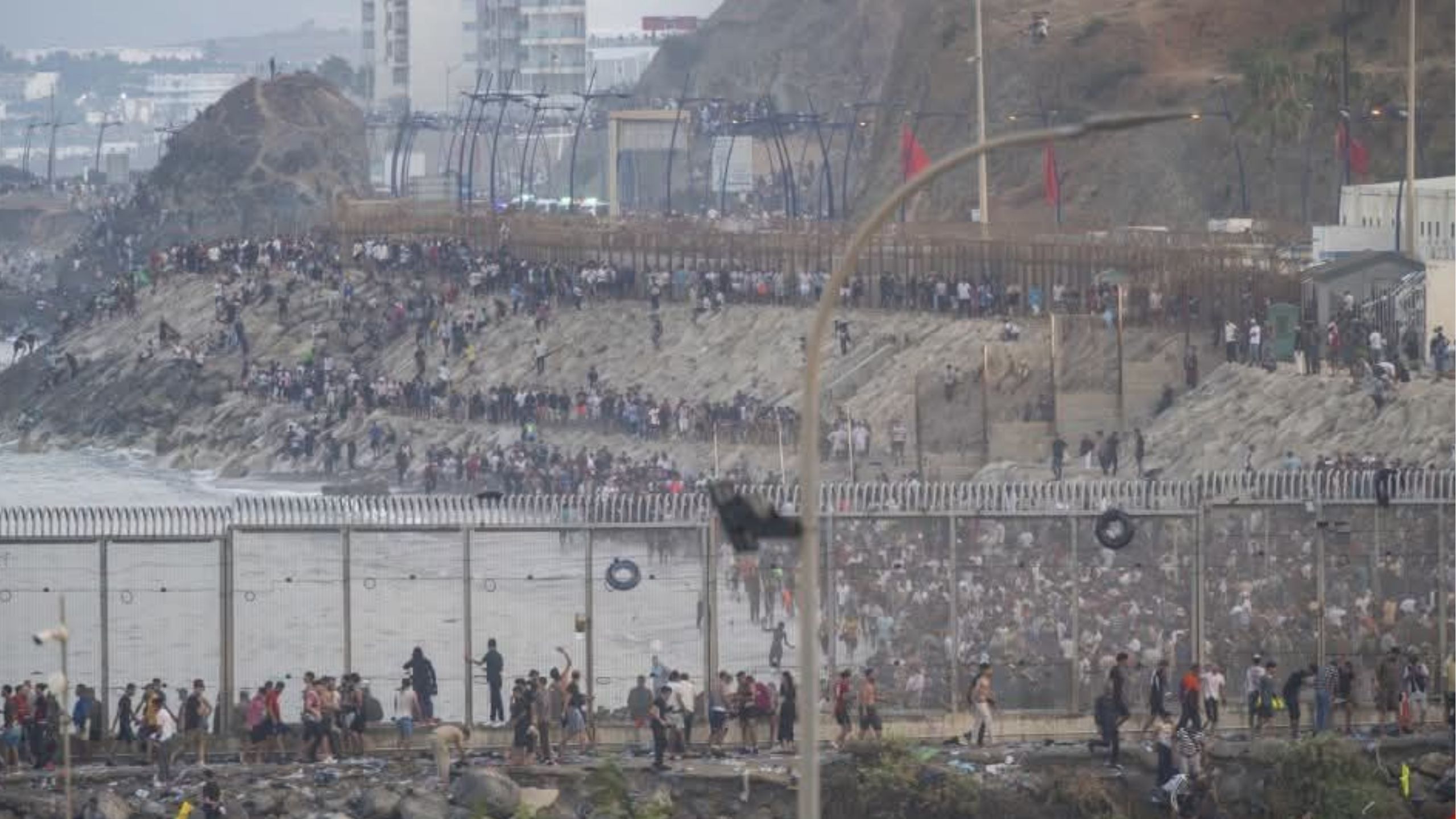
Thousands of people from Morocco swim to and enter Spain's North African enclave of Ceuta during a mass migration crossing.
Europe is once again confronting a familiar but increasingly difficult dilemma: how to protect its external borders while remaining faithful to the democratic values on which the European Union was built.
According to Reuters, as published by CNN on July 31, 2026, around 49,000 migrants crossed by land and sea from Morocco into Spain's North African enclave of Ceuta within a single day, making it the largest migration surge the territory has experienced since at least 2021.
Reuters, citing Spanish authorities, also reported that at least 19 bodies had been recovered from the water following the mass crossings. The humanitarian cost is immediate. The political consequences may prove far more enduring.
Reuters further reported that Spain and Morocco reinforced the border the following day, with Moroccan security forces deploying additional personnel and equipment to stem further crossings, while Spanish authorities moved to restore control and announced that illegal entrants would be returned in accordance with Spanish law, court rulings and applicable human rights obligations.
The crisis has also exposed growing divisions within Europe itself.
According to Agence France-Presse (AFP), published by NDTV and other international outlets, Italian Prime Minister Giorgia Meloni called for extraordinary measures—including the possible suspension of Spain from the Schengen Area if the situation continues—arguing that uncontrolled irregular migration poses a serious threat to Europe's external border security.
Reuters likewise reported that Meloni warned Italy was prepared to support exceptional measures to defend Europe's borders. Italian Foreign Minister Antonio Tajani publicly backed a review of Schengen arrangements with Spain, while Deputy Prime Minister Matteo Salvini argued for suspending the Schengen system altogether.
Spain firmly rejected those proposals. Reuters reported that Spanish Foreign Minister José Manuel Albares described Tajani's remarks as "inappropriate" and said Spain expected European solidarity rather than partisan rhetoric.
The dispute reflects a broader reality. Migration is no longer viewed solely as a humanitarian issue. Across much of Europe, it has become inseparable from debates over border security, public confidence and the future of European integration.
Europe understands the consequences of security failures. Madrid's train bombings in 2004, London's attacks in 2005, the atrocities in Paris, Brussels, Berlin, Nice, Stockholm and Vienna transformed the continent's approach to counter-terrorism. As documented by the Council of the European Union, member states subsequently expanded intelligence cooperation, strengthened Europol and Eurojust, modernised border information systems, tightened controls on terrorist financing, enhanced firearms legislation and introduced new measures targeting foreign terrorist fighters and online extremist content.
Today's European security framework is significantly more robust than it was two decades ago.
Yet European intelligence and security agencies themselves acknowledge a difficult reality. No democracy can identify every future attacker or eliminate every risk while remaining governed by the rule of law.
Intelligence services monitor known extremist networks, investigate suspected threats and exchange information across borders, but they cannot lawfully detain or restrict individuals without sufficient evidence. Absolute security is neither achievable nor compatible with democratic principles.
That reality makes effective border management all the more important.
Every sovereign state has both the right and the obligation to know who enters its territory. When tens of thousands of people arrive within a matter of hours, authorities must verify identities, process asylum claims, identify vulnerable individuals, dismantle human-smuggling networks and conduct security screening.
These responsibilities become considerably more demanding when border systems are placed under exceptional pressure.
None of this should be interpreted as suggesting that migrants or refugees are terrorists. The overwhelming majority are not, and there is no credible evidence that migration, by itself, inevitably leads to terrorism. Conflating migration with terrorism is both inaccurate and counterproductive. It weakens evidence-based policymaking, fuels unnecessary social division and distracts attention from genuine security threats.
At the same time, governments cannot ignore legitimate public concerns about border control. Public confidence depends upon the ability of states to enforce immigration laws fairly, operate efficient asylum systems and ensure that security screening remains effective. A loss of confidence in border management can quickly become a loss of confidence in democratic institutions themselves.
The wider implications extend far beyond Spain.
Under the Schengen system, Europe's internal freedom of movement depends upon confidence in the protection of its external borders. Developments in Ceuta, Lampedusa or the Greek islands inevitably affect the entire European Union. Migration policy is therefore not simply a national issue; it is a shared European responsibility requiring close coordination, intelligence cooperation and common legal standards.
Reuters reported that Spanish officials believe several factors may have contributed to the sudden surge, including the practical implications of a recent Spanish Supreme Court ruling affecting the return of some migrants intercepted while attempting to reach Ceuta or Melilla. Whether that proves to be a decisive factor remains a matter for further analysis, but the episode illustrates how legal, humanitarian and security considerations can quickly intersect.
Enjoying this article?
Subscribe to get more stories like this delivered to your inbox.
The political debate surrounding Ceuta ultimately reflects a larger strategic question. Can Europe remain open while maintaining effective control of its borders? Can it continue to offer protection to those genuinely fleeing war and persecution while preventing criminal networks from exploiting vulnerable people? Can it reassure anxious citizens without compromising the rule of law or the democratic freedoms that define European societies?
These questions cannot be answered through slogans or political point-scoring.
Europe possesses some of the world's most advanced intelligence services, experienced law enforcement agencies and sophisticated legal institutions. As the Council of the European Union notes, cooperation among member states has prevented numerous terrorist plots and significantly strengthened Europe's collective security over the past two decades.
Yet evolving threats—from organised extremist groups to self-radicalised individuals and transnational criminal organisations—mean that vigilance will remain essential.
The events in Ceuta should therefore serve as a warning rather than a source of political division. Migration policy cannot be separated from security policy, just as security policy cannot succeed without public trust, effective governance and respect for fundamental rights.
Europe's defining challenge is not choosing between security and humanity. It is demonstrating that a democratic society is capable of defending both. How Europe responds to Ceuta will shape not only the future of Schengen, but also the credibility of the European project itself.
Contributing writer at The Independent News