
Bangladesh: A land of dreams or a nation losing faith in its own future?
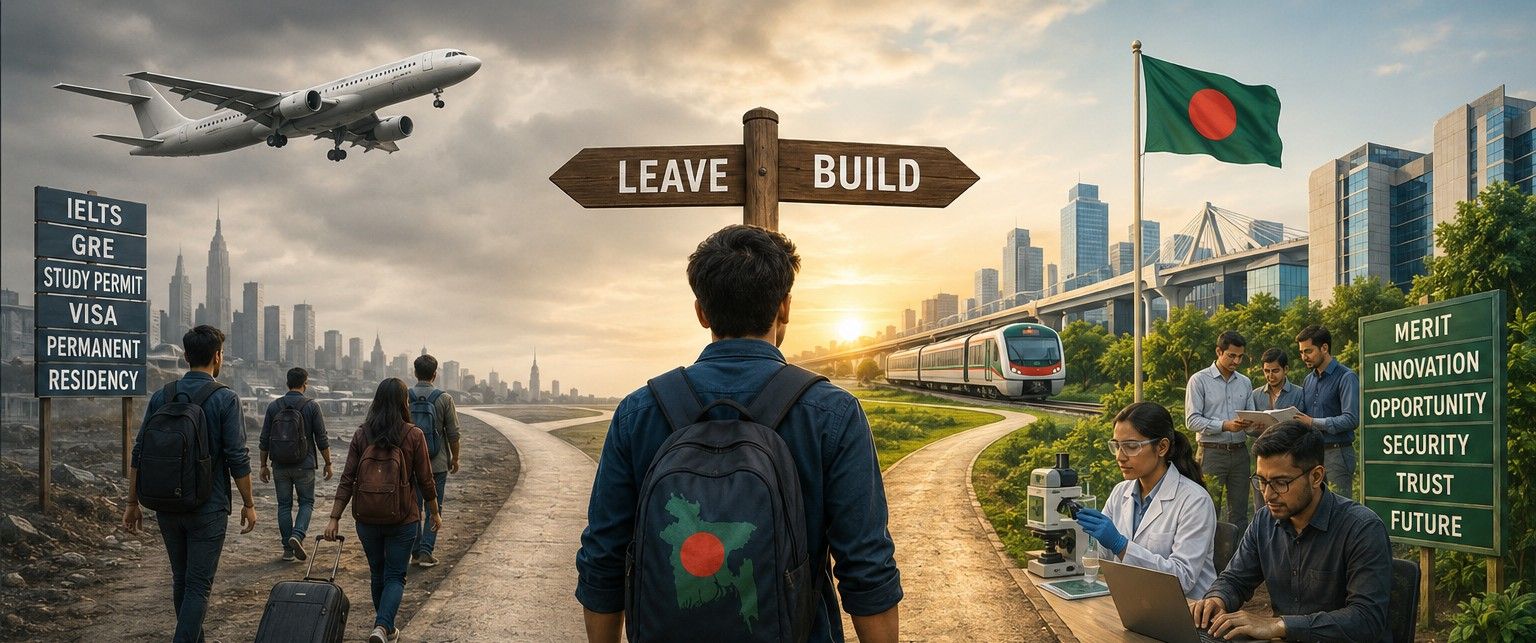
At the Crossroads of Ambition: As increasing numbers of young Bangladeshis pursue education and careers overseas, the nation's greatest challenge is not simply preventing migration, but creating a future where talent chooses to stay—or confidently returns. Sustainable progress depends on institutions that reward merit, foster innovation and inspire trust in tomorrow.
There was a time when the greatest ambition of young Bangladeshis was to earn a place at a respected university, secure a government job, or build a dignified life at home. Today, that dream has taken on a different language. IELTS, GRE, study permits, permanent residency and skilled migration have become the new vocabulary of aspiration. When a son or daughter leaves for higher education abroad, it is no longer viewed simply as an academic achievement; for many families, it has become a symbol of success and social prestige.
This raises an uncomfortable but necessary question: why are so many of Bangladesh's brightest students reluctant to return after studying overseas? Why do thousands spend years pursuing visas to countries they have never seen? The answer extends far beyond higher salaries. It lies in a deeper search for fairness, opportunity, security, institutional trust and confidence in the future.
Many young Bangladeshis believe that hard work alone does not always guarantee success. A widespread perception persists that connections, influence, and personal networks can matter as much as, or sometimes more than, merit. Whether or not this reflects every individual's experience, such perceptions shape expectations. As a result, many see developed countries as places where the rules of competition are more transparent and professional achievement is more closely linked to ability.
Economic realities reinforce this perception. Graduates often enter a labour market where quality jobs are limited and starting salaries struggle to keep pace with the rising cost of living. By contrast, developed economies frequently offer stronger earning potential, clearer career progression and wider professional opportunities. Yet income alone does not explain why so many choose to stay abroad.
The lives of international students are rarely as glamorous as social media suggests. Many balance demanding academic schedules with part-time work in restaurants, warehouses, retail, or delivery services. They cope with homesickness, language barriers, cultural adjustment and financial pressure. Despite these challenges, many remain because they believe that today's sacrifices can lead to tomorrow's opportunities. Above all, they trust that effort is more likely to be rewarded.
That confidence is perhaps the most important difference.
History shows that no country retains talent through patriotic appeals alone. People stay—or return—when they believe they can build meaningful careers, contribute to society and enjoy fair opportunities.
China offers an instructive example. For decades, millions of Chinese students pursued education abroad. While many settled overseas, successive governments invested heavily in research, advanced manufacturing, artificial intelligence, higher education, and innovation. Competitive salaries, world-class laboratories, and generous research funding encouraged a significant number of scientists, engineers, and entrepreneurs to return. China did not simply ask its talent to come home; it created compelling reasons for them to do so.
India presents a similar, though distinct, story. Following economic liberalisation, sectors such as information technology, pharmaceuticals, space research, and entrepreneurship expanded rapidly. Cities including Bengaluru, Hyderabad, and Pune emerged as global technology hubs. Many Indians educated overseas have remained abroad, but many others have returned to establish companies, lead research, create jobs, and strengthen the country's innovation ecosystem. The critical lesson is not that everyone returned, but that returning became a realistic and attractive option.
South Korea's transformation is even more striking. Devastated by war and once among the world's poorest nations, it invested consistently in education, scientific research, industrial policy and technological capability. Universities, research institutes, and industry worked together to support national development. Today, global companies such as Samsung, Hyundai, LG, and Kia offer highly skilled professionals world-class career opportunities without requiring them to leave their country.
Singapore tells another remarkable story. Despite its limited natural resources, it recognised that human capital would become its greatest asset. Through effective governance, strict anti-corruption measures, an efficient civil service, internationally competitive education, and a business-friendly environment, it built one of the world's most dynamic economies. The country attracts talented professionals from across the globe because it offers something that cannot be measured by salary alone: confidence in institutions and confidence in the future.
These countries differ enormously in history, politics and culture. Yet they share one common principle: they did not rely solely on patriotic rhetoric. They built systems that rewarded competence, encouraged innovation, and created genuine opportunities.
Bangladesh faces a different reality. The country produces talented graduates, engineers, doctors, scientists, and researchers every year. What remains in shorter supply are world-class research facilities, robust innovation ecosystems, transparent recruitment, predictable career paths, and institutions that consistently reward merit.
This is why many Bangladeshis who leave for higher education choose not to return. Better salaries certainly matter, but so do professional independence, research opportunities, public safety, quality healthcare, efficient public services, legal certainty, and the belief that the future can be planned with confidence. Many are making decisions not simply about jobs, but about the lives they hope to build for themselves and their children.
If Bangladesh is serious about reversing this trend, retaining talent must become a national priority.
The education system should be aligned more closely with the demands of a rapidly changing global economy. Universities must evolve from institutions that primarily award degrees into centres of research, innovation, and entrepreneurship. Investment in science, technology, and research should increase substantially. Recruitment across both the public and private sectors should become more transparent and merit-based. Administrative barriers facing entrepreneurs should be reduced, while innovation and start-up ecosystems require stronger financial and institutional support.
Enjoying this article?
Subscribe to get more stories like this delivered to your inbox.
The Bangladeshi diaspora also represents an extraordinary national asset. Thousands of highly qualified professionals work in leading universities, hospitals, technology companies, and research institutions around the world. Even if many do not return permanently, they can contribute through collaborative research, investment, technology transfer, mentorship, and academic partnerships. National policies should actively encourage such engagement.
Responsibility, however, does not rest with government alone.
The governing party, the opposition, and every major political force should recognise that human capital is not a partisan issue but a national one. Long-term reforms in education, research, judicial independence, public administration, anti-corruption efforts, and employment policy require continuity beyond electoral cycles. Countries build prosperity when institutions remain stable, regardless of changes in political leadership.
Ultimately, Bangladesh's greatest challenge is not merely economic—it is a crisis of confidence.
People stay where they believe that talent will be recognised, hard work will be rewarded, and the future remains worth investing in. When that confidence weakens, migration becomes more than an economic decision; it becomes an expression of hope placed elsewhere.
Bangladesh does not need to replicate China, India, South Korea, or Singapore. Every nation follows its own historical path. But it can learn from a lesson they all demonstrate: sustainable development depends not only on roads, bridges, or skyscrapers, but on institutions that inspire trust, protect fairness and unlock human potential.
The true measure of a successful nation is not how many of its brightest citizens leave, but how many choose to return—and how many never feel compelled to leave in the first place. When Bangladesh becomes a country where talent can flourish, ambition can be rewarded, and integrity can succeed, studying abroad will no longer represent a one-way journey. It will become what it should always have been: an opportunity to learn from the world before contributing to the nation that first nurtured those dreams.
Contributing writer at The Independent News